
Listen on your favorite platform


Episode Overview
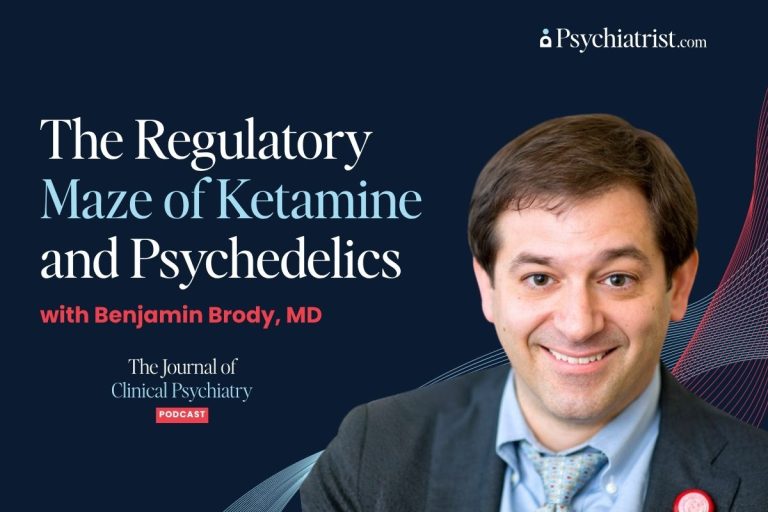
Dr. Benjamin Brody, an inpatient psychiatrist who built and now directs one of the earliest hospital-based ketamine treatment programs, joins Dr. Ben Everett to unpack the regulatory maze surrounding ketamine and the psychedelics now approaching FDA approval. Dr. Brody traces how he moved generic racemic ketamine from an overlooked anesthetic sitting on the hospital pharmacy shelf to a formally sanctioned inpatient treatment, and explains why esketamine’s REMS-regulated pathway looks nothing like the largely unregulated market for take-home ketamine.
As synthetic psilocybin nears a possible FDA decision and the field debates what role psychotherapy should play alongside these treatments, clinicians face fast-moving questions about safety monitoring, staffing, informed consent, and reimbursement. Drawing on his direct experience administering ketamine on the inpatient unit, Dr. Brody discusses self-escalation risk, the paradox reaction his team termed dysphoric dissociation, and what health systems should weigh before building a program of their own.
Key Episode Highlights
⚠️ THE NARROW LINE BETWEEN NEUROTROPHIC AND NEUROTOXIC [18:30]
“But at higher doses, it actually becomes neurotoxic and, you know, there’s histopathological changes that can be seen.”
At therapeutic doses ketamine is safe and neurotrophic, but Dr. Brody warns that self-escalating doses can quickly cross into neurotoxic and bladder-damaging territory.
🧠 DEFINING DYSPHORIC DISSOCIATION [24:00]
“This is a dysphoric piece or a dysphoric reaction that is layered on top of the dissociative experience for this small minority of patients.”
Dr. Brody explains why his team coined a new clinical term to distinguish ketamine’s rare, frightening paradox reaction from a psychedelic “bad trip,” and why naming it matters for informed consent.
🚫 THE CASE AGAINST TAKE-HOME KETAMINE [25:00]
“The unambiguous answer is no, I do not think this is a good idea.”
Citing self-escalation risk, a narrow therapeutic index, and a growing number of ketamine-associated deaths, Dr. Brody explains why he opposes direct-to-consumer telehealth ketamine prescribing.
Episode Chapters
00:00 – From Creative Writing to the Inpatient Unit
02:30 – A Day in the Life of an Inpatient Psychiatrist
05:30 – How Dr. Brody Came to Believe in Ketamine
12:00 – Ketamine vs. Classical Psychedelics: A Different Mechanism
14:00 – Two Regulatory Worlds: Racemic Ketamine and REMS-Regulated Esketamine
17:30 – Safety Signals: Self-Escalation and Dysphoric Dissociation
24:30 – The Case Against Take-Home Ketamine
29:30 – Psychedelics Enter the Medical Mainstream
33:30 – What to Expect When Psilocybin Gets FDA Approval
39:00 – Staffing and Consent for Hours-Long Sessions
43:00 – Set and Setting: Lessons from Building a Ketamine Program
48:00 – Is This Psychotherapy? Defining the Clinician’s Role
54:00 – What Surprised Dr. Brody About Implementation
57:00 – Advice for Health Systems and Reasons for Optimism
podcast alerts
Get the latest episodes
Additional Resources
Back to top
Further Reading

Journal of Clinical Psychiatry
Publisher of peer-reviewed research discussed in this episode.
How Do We Get Ketamine Safety Right? Three Questions From a Clinical Service
Dr. Brody’s 2025 JCP commentary on self-escalation, paradox reactions, and the regulatory gap between racemic ketamine and esketamine, discussed at length in this episode.
COMPASS Pathways – COMP360 Psilocybin for Treatment-Resistant Depression
https://compasspathways.com/our-work/comp360-psilocybin-treatment-in-trd/
The investigational psilocybin program discussed throughout the episode, including its phase 3 timeline and proposed psychological support model.
Dr. Benjamin Brody – LinkedIn
The Guest
Dr. Benjamin Brody oversees seven inpatient psychiatric units at Cornell, caring for roughly 145 patients at a time. After finishing his psychiatric training in 2011, he built the clinical and regulatory case for using ketamine on the inpatient units, treating his first patient in 2019. He also sees patients individually through his institution’s physicians organization and recently co-authored a 2025 commentary in the Journal of Clinical Psychiatry examining ketamine safety in clinical practice.
The Host
Ben Everett, PhD, is the creator and host of The JCP Podcast, a series that brings together leading voices in psychiatry to explore the latest research and its clinical implications. Everett earned his PhD in Biochemistry with an emphasis in Neuroscience from the University of Tennessee Health Science Center. Over a two-decade career spanning academia, publishing, and the pharmaceutical industry, he has helped launch more than a dozen new treatments across psychiatry, neurology, and cardiometabolic medicine. His current work focuses on translating complex scientific advances into accessible, evidence-based insights that inform clinical practice and foster meaningful dialogue among mental health professionals.
Full Episode Transcript
This transcript has been auto-generated and may contain errors. Please refer to the original audio recording for full accuracy.
00:00 – From Creative Writing to the Inpatient Unit
Dr. Benjamin Brody: All right, with that, Dr. Brody, welcome to the podcast.
Thank you so much. It’s really a pleasure to be here.
Dr. Ben Everett: I really want to start someplace that your CV doesn’t really capture. And that is, before you got into medicine, you actually worked as an editor, and you also won awards for some writing you did as an undergrad.
You did fiction, you wrote some plays. I’m curious if or how that part of your background shows up in the way you think about psychiatry and patient care.
Dr. Benjamin Brody: Ben, we’re just meeting for the first time, but you’re already making me blush. I had not expected those skeletons to come out of the closet. Going back to childhood, high school, early adolescence, I was very interested in, in stories, writing, fiction television and film.
And those things were also paired with an interest in psychology. I took psychology in high school and loved it. My mother was a inpatient social worker at the University of Pittsburgh in the Western Psychiatric Institute Clinic, which we refer to as WPIC back there in Pittsburgh.
And and these were two interests of mine that always coincided, and certainly I think, people’s stories, what makes them work, what makes them motivated, the worries that they have, the concerns, the problems that emerge in their life are both the stuff of literature and the stuff of mental health writ large.
So certainly I think they inform each other and, and were an, an early set of interests of mine that, that coexisted.
02:30 – A Day in the Life of an Inpatient Psychiatrist
Dr. Ben Everett: All right, well, thanks for that background. Your day-to-day work, you oversee seven inpatient units, so you’re seeing really broad cross-section of psychiatry. A lot of the guests we have on, they focus on one particular, area of, of research or passion.
They… mostly schizophrenia or mood disorders or treatment-resistant depression. But in your day-to-day, you’re really faced with the whole swath of serious mental illness in the inpatient unit, everything from, uh, psychosis to mania, severe depression, suicidality.
So I’m curious what a typical week looks like for you.
Dr. Benjamin Brody: Well, you’re, you’re absolutely right. There are all kinds of patients coming through our inpatient services for all kinds of reasons. And, uh, the units I see I have oversight responsibilities for, today have about a hundred and forty-five patients on them, and they’re having all kinds of different challenges.
And so, you know, the consistent part of, of my day on a day-to-day basis is working with the teams, working with the psychiatrists, the psychologists, social workers the nursing leadership to make sure that we can give all those patients the absolute best care we can on a day-to-day basis, recognizing that every one of them have slightly unique and slightly specific challenges.
And at the same time, recognizing that the problems do fit into these broad categories and these, these– we do have a good evidence base for many, many of these conditions, and we wanna try to bring the best possible care to these patients as as best we can day by day, week by week. And so, you know, my mornings involve a lot of talking to our teams.
Sometimes if someone is out, if somebody’s sick, I may jump in and, and see patients myself and put myself on service talk to my clinicians about the biggest struggles that they’re having with particular questions. Um, then in the afternoon, I tend to switch gears a little bit and work on some longer-term issues.
Just a few minutes ago, I was working on a an issue with our EMR Epic with some of my colleagues to just improve our documentation slightly. I might work with our research assistant on an IRB amendment for a research study that we’re working on. I might revise you know, a paper or work on a manuscript.
And then I generally finish the day by seeing one or two patients as a psychiatrist in a one-on-one basis in our physicians organization, and that really grounds me in a separate way to work with patients directly and, and to remind myself of, the kinds of problems they’re facing and, and what it’s like to be a doctor who’s doing direct care.
And so all those things are, are synergistic for me and inform one another and have been part of my practice to some extent or another, really for about fifteen years since I, I finished my training back in, in twenty eleven.
Dr. Ben Everett: Well, thanks for that background. I really love how you end the day by seeing a couple of patients and you say, you know, that kind of grounds you in your psychiatry, uh, background and, and everything else.
05:30 – How Dr. Brody Came to Believe in Ketamine
Dr. Ben Everett: think that’s really important and, um, I’m sure it shows up in the work you do for the rest of your job as well. But look, let’s get into ketamine itself. We know ketamine has been around for a long time, originally approved back in 1970, long before anyone was thinking about it as a treatment for depression.
I’m curious how you came to get interested in it and what made you think, “Hey, this, this will be a good tool for us to use in an inpatient setting”?
Dr. Benjamin Brody: Yeah, absolutely. So it really goes back to you know, as I said a minute ago, I finished my training in twenty eleven, and that was a very specific moment, I would say, for mood disorders research and, and, you know, for, for psychiatry as a field.
Um, and it was not a tremendously optimistic moment. Um, the STAR*D trial had just ended and, you know, you had a great discussion with John Rush a little ways back on this podcast and, you know, he talked about some of those results. But you know, some of those– some of the big takeaways from that was that it takes a long time for antidepressants to work.
And if you don’t respond to a first or second-line treatment with a standard monoamine antidepressant, so those are the SSRIs and the SNRIs the bupropions and the like, the likelihood of you responding to third and fourth-line treatments diminishes substantially and really, really falls off, off very substantially when those, those first treatments have failed.
So treatment-resistant depression was a substantial problem. The fact that the treatments took a long time to work was a substantial problem for the inpatient units where I was, beginning my career. So we just are not able to keep patients in the hospital for two to three months, and patients certainly very understandably don’t want to stay in the hospital for two or three months.
So there was a lot of interest and effort around looking, you know, to try to treat patients faster and get patients out of the hospital faster. But, you know, some of the, some of the results from STAR*D, for example, there was a lot of pharmaceutical companies that were getting out of the, uh, mental healthcare space because they just did not see this as, as something that was gonna be a solvable problem at the time.
There was a very nice editorial or commentary written by Steven Hyman, former director of, uh, NIMH and the provost at Harvard talking about the industry running away from mental health and the problem that was gonna be. Uh, but there was one bright spot in the literature at the time, which was there were these studies starting first in the year two thousand at Yale that showed that ketamine has rapid-acting antidepressant properties.
These are initially very small studies with following patients for short time frames. But I saw these and I said, “Well, listen, I mean, this is sort of hiding in plain sight. This is already on our hospital formulary. It’s in our, pharmacy. We should use this.” And I went to my clinical director at the time, a terrific administrative and emergency psychiatrist named, uh, Dr.
Lisa Sombrotto, who’s still with our organization in a somewhat different capacity. And I said to her, “You know, I want to do this. I want to use ketamine on the inpatient units.” And she said, “Well, you can’t just, go down to the pharmacy and, and start giving it to patients. You’d have to write a hospital policy, and you’d have to go in front of the hospital medical board and get privileges to administer ketamine.
In order to do that, you’d really have to convince the leadership of the hospital that, that this is really standard of care. And at this point, the evidence looks, you know, pretty thin. This looks like research. This doesn’t look like clinical care at this point.” Uh, but to her credit, she said, you know, “Just follow the story, follow the evidence, and when this really starts to accumulate further, come back and we can talk about this more.”
I would say probably four or five years passed before from some of those initial discussions I had. I’m probably, forgetting the exact dates. But then in twenty-seventeen, a couple of, of very substantial things happened. Um, the first was some of our colleagues up at Columbia in John Mann’s group published a study that showed that suicidal ideation in patients with major depressive disorder decreased substantially within a day or so of having a single ketamine treatment, and it remained substantially diminished, intensity of the suicidal ideation, that is, for about six weeks.
And I said, “Well, you know, first of all, that’s how long the standard antidepressants take to work. And second of all, if we can reduce suicidal ideation, that gives us enough time to engage with patients in other forms of treatment.” And, at this point, this is, this is, I think, you know, moving towards prime time.
But then the, the final piece of it really was that the, uh, American Psychiatric Association Council on, uh, Novel Therapeutics and Biomarkers, um, I may be mis- Misremembering exactly what that council’s name is, but they published a consensus statement in 2017 that talked about how to use ketamine safely.
And the authors, the first author was Gerald Sanacora from Yale and Alan Schatzberg, Charlie Nemeroff. These are some of the, the biggest names in affective disorders. And so I went back to our clinical leadership and I said, “Okay, we have a consensus statement from some of the biggest names in the field that says this is how you can do this, this is how you can do it safely.”
At that point she agreed with me. She said, “Yes, let’s write policy and, and let’s institute this.” Um, and then it took another year or so to, get all of our ducks in a row to get those policies approved, go in front of the medical board of the hospital to set up nursing protocols, and then to start administering ketamine.
And so we treated our, our first patient in 2019.
12:00 – Ketamine vs. Classical Psychedelics: A Different Mechanism
Dr. Ben Everett: all right, well, thanks for that. So we’re gonna really get into a lot of details and a lot of what just came out of that answer right there. But, for now, let’s maybe take a step back and just talk about ketamine broadly. It often gets lumped in with the psychedelics or, or I could say classical psychedelics, although it’s really quite different, uh, mechanistically.
And without getting too much into, you know, receptor pharmacology and whatnot, can you just talk about, why ketamine is a little bit different from, say, psilocybin or LSD?
Dr. Benjamin Brody: Sure, absolutely. I think you’re absolutely right. It does get lumped in with, with some of the psychedelics and they are all they are distinct.
And, ketamine is what’s called a, a dissociative anesthetic. Um, so it’s a general anesthetic agent. That’s what it was first approved for. And in terms of the receptor systems that it’s working on, it is distinct from classical antidepressants. It’s not working on those monoamines, serotonin, norepinephrine, and dopamine.
Its primary effect is thought to be through the glutamate system, through antagonism of the NMDA receptor, but it also serves as a weak agonist of the mu-opiate receptor, and then subsequently through downstream effects that lead to a rapid increase in neurotrophic factors and dendritic spine formation.
And this is really how the, uh, antidepressant effects are, are, are felt to be mediated on a neurobiological level.
Dr. Benjamin Brody: The experience that patients have when they’re exposed to ketamine at sub-anesthetic doses, which are the doses that are used for the treatment of depression are substantially different than the kinds of experiences that patients have or individuals have when they take a classic psychedelic like psilocybin, as, as you mentioned.
We can get into some of those, what those differences are, because they are substantial and they have substantial implications for what one might do or what kind of experience a patient might have when they’re exposed to the agent, what role a therapist or, um, individual who’s trying to keep the person safe during that experience might do, and the like.
14:00 – Two Regulatory Worlds: Racemic Ketamine and REMS-Regulated Esketamine
Dr. Ben Everett: All right, so let’s shift from the science and really delve into the implementation now. One thing I came to appreciate when I was working in psychedelic drug development is that getting good clinical data is only part of the challenge. Actually delivering the novel treatment safely in the real world can be just as complicated as you found when you, wanted to bring this into your service.
So you know, it does make a interesting regulatory case as well because we’ve got the generic racemic ketamine that is widely available. Really anyone with a DEA license can prescribe it. But we also have this branded esketamine Spravato that is tightly regulated under our REMS program. How do you make sense of this regulatory landscape right now?
Dr. Benjamin Brody: It’s an accidental a- after effect of the way that the ketamine became really used in psychiatric practice, which is to say that, you know, it’s essentially a repurposed drug. It was approved by the FDA back in 1970, as you said, as a general anesthetic, and there was really no consideration that this was gonna be used in outpatients.
There was no consideration that this was gonna be used for mental health purposes. And so, at that time, the thinking was this was gonna be used as a general anesthetic. So There’s no REMS system about giving any guidance for whether it should be administered directly to patients to take home and try, to administer to themselves at home.
There’s no guidance around how long you might monitor a patient because the assumption is that they’re in perioperative settings or operative rooms and, and the anesthesiologists don’t need to be reminded of how, how to do that. And then esketamine is an entirely different landscape. So Janssen sees this happening, sees this this opportunity to take the S enantiomer of ketamine and patent it and use it in a, uh, nasal spray formulation.
That’s also part of their patent as the distribution method. And that it also shows, you know, enough signal to to meet regulatory approval for antidepressants initially as an add-on treatment to a standard antidepressant, and then subsequently also for suicidal ideation in the context of major depression.
But when it’s approved, it’s approved with a very specific REMS system, which is a Risk Evaluation and Mitigation System. And we, we… psychiatry has used and had systems like this for clozapine, although that was recently repealed. And so when esketamine comes to the market, it comes with very, very specific guidance about how it’s supposed to be administered.
Which is to say, it’s supposed to be administered in a healthcare setting, not distributed directly to patients. And then the patients are supposed to be watched, monitored in terms of their blood pressure, in terms of their, uh, mental status for two hours post-administration. And this is really quite critical because it really ensures patient safety, and they’ve published a lot of safety data that is, uh, very reassuring both for acute treatment and, and going out several years at this point.
So we have a very distinct you know, regulatory landscape for esketamine, which is different from, frankly, the absence of a significant mechanism to regulate the older racemic version of ketamine that is distributed in, in all kinds of formulations and in all kinds of ways. And that, you know, subsequently starts to lead to some problems.
17:30 – Safety Signals: Self-Escalation and Dysphoric Dissociation
Dr. Ben Everett: Well, speaking of those problems, I know you’ve written quite a bit about this, and in fact, you had a 2025 commentary with some, some co-authors.
It was published in JCP. What were you really trying to highlight in that piece?
Dr. Benjamin Brody: Yeah. So really kind of a couple of things. We were really sort of focused on safety in that piece, and, and we, we wanted to kind of highlight a couple of, of different pieces that emerged. The first is that we, we started to see patients come into the hospital and say, I’d like ketamine.
I’m here for ketamine. And by the way, I’ve gotten ketamine down the road, and, you know, this doctor gives me a higher dose of ketamine than you’re prescribing.” And we said, “Now wait a second. We, we probably need to pay attention to this.” Because at low doses, ketamine is neurotrophic, as, you know, I mentioned a, a few moments back.
But at higher doses, it actually becomes neurotoxic and, you know, there’s histopathological changes that can be seen. There’s cognitive deficits that can be seen and you know, those are at, uh, substance use doses. At the therapeutic doses that are being used in practice it’s actually a quite safe medication.
But if patients start to self-escalate their doses, if patients are given the medication to take home, well, then we have a more concerning landscape that we’re moving into. So that was one piece. The second piece that I wanted to highlight with my colleagues in that piece is that we started to see some patients 2%, 3%, 4% who had something of a paradox reaction when ketamine was administered to them, which is to say that they found the experience very terrifying, frightening and several patients became acutely suicidal.
And, you know, the good news with ketamine is that it’s has a pretty short half-life. It’s metabolized very rapidly. The dissociative effects are very transient. So if you’re with patients, you can keep them safe. Those reactions are very short-lived and patients get better and, you can move them onto a different treatment if they have a paradox reaction to ketamine.
We, we’ve called that dysphoric dissociation. I can say a little bit more about why. These are, these are very transient. But nevertheless, they can be very terrifying to patients and of course potentially very dangerous if patients are not in a monitored setting, if they’re at home when they have an experience like this.
So really that was, that was the, the second piece that, uh, we really wanted to highlight in that particular piece. And then, you know, the third thing that, you know, we can certainly also talk about more is that, you know, this regulatory landscape is gonna have implications for the expectation that we’re gonna have psychedelics approved, you know, very soon probably a psilocybin formulation first.
And this is gonna be a new kind of treatment for psychiatrists that probably looks to some extent like ketamine and esketamine in terms of administration that is spaced apart by some amount of time in some sort of monitored setting, but nevertheless is not going to be the sort of thing that you’re taking on a day-to-day basis and is not going to be the kind of thing where you could have a, a very, very brief conversation with patients and say you know, the side effects may be some sexual side effects.
You may have a little bit of nausea or, GI upset the first time you take a couple of pills. It’s possible that you’ll gain a pound or two, but otherwise, you know, the side effects are, are really quite mild.” So it’s, it’s not the same kind of conversation at all with these kinds of, of interventions for for patients with depression or some of the other myriad mental health conditions that ketamine and psychedelic treatments are being used for, or in the case of psychedelics you know, potentially used for, um, or used for in research settings right now.
And so we have to talk about these, these distinctions, we have to talk about how to have these conversations. We have to talk about what the regulatory landscape should look like for these types of interventions so that our field is prepared. We’ve got something like 60,000 psychiatrists in the United States.
We have another 60,000 or so advanced practice practitioners who are prescribing psychotropic medications. We have, you know, hundreds of thousands of primary care doctors, psychologists master’s levels therapists who are going to have questions about these kinds of things. And this is just not something that our field is has, has a really good framework to address to have those conversations.
So we wanted to highlight some of those things.
Dr. Ben Everett: All right, so you did mention the term dysphoric dissociation. I am curious how you came up with that. Why was that the right term?
Dr. Benjamin Brody: Sure. This- the first piece of this is just, well, what does dissociation mean?
What is a dissociative experience? Dissociation is an experience where people feel somewhat separated from themselves. They may feel like they’re floating outside of their body. They may feel l- a sense of unreality as though they’re in a movie. They can have some perceptual disturbances, but those are more along the lines of feeling that time is moving very, very slowly or time is moving very rapidly, almost proprioceptive kinds of disturbances.
Their limbs may feel incredibly heavy or limbs may feel incredibly light, or they may feel these sorts of distortions. So this- these are the classic dissociative experiences that patients report when they are administered ketamine. Now, some individuals find that to be a pleasant experience. And of course, this is why ketamine is a substance of misuse and was used in, the ’80s and ’90s in recreational settings and raves and the like.
And so some people like this experience, they find it exciting. There’s an affective valence that can be positive. Now, many patients don’t really have much of an affective experience with it at all. They say, “Well, it was kind of odd, sort of a strange experience, but, you know, it didn’t really, didn’t, wasn’t really pleasant or unpleasant.”
Um, but then there’s this small minority who really find it terrifying, who really find it unpleasant. And again, this is not the same thing as a psychedelic. This is sort of a little bit distinct from a quote, unquote, “bad trip.” And we were kind of trying to make that distinction. We were trying to say, you know, this is a dysphoric piece or a dysphoric reaction that is layered on top of the dissociative experience for this small minority of patients.
We have to be aware of this, and we have to, to, y- both monitor patients and also talk about this probably in the informed consent process so that patients aren’t shocked if it happens. And uh, so that is, you know, something we started doing a number of years ago. So it felt like the right term to make a distinction between calling something, just unpleasant or a quote, unquote, “a bad trip,” which, isn’t really accurate or, doesn’t really medically capture, you know, what’s happening with these patients. Um, so that’s kind of how we got to that term.
24:30 – The Case Against Take-Home Ketamine
Dr. Ben Everett: Nice. All right, well, let’s change gears just a minute, and I’m curious what your thoughts are on the direct-to-consumer telehealth model for ketamine that grew out during the pandemic.
Do you have concerns with this model, or do you think it’s okay to keep on doing this?
Dr. Benjamin Brody: Yeah. Listen, let me be clear. The unambiguous answer is no, I do not think this is a good idea. I do not think that we should be prescribing ketamine directly to patients to take home with them and to administer at home.
Why is that? A number of reasons. The first, of course, is that it is a substance of misuse. Patients can self-escalate their doses. And, unlike something like a stimulant or benzodiazepine, you know, this is, this is a general anesthetic. So if you Self-increase your dose, you can get into a state where you are essentially, anesthetized you know, pretty quickly if you’re using a, a higher dose than is prescribed.
Um, and then, there’s this, this idea that there’s probably a pretty narrow therapeutic index. I had said a few minutes ago, at a certain point at these therapeutic doses, it’s neurotrophic, but then pretty quickly you get into neurotoxic ranges, and we’re not exactly sure what… where the delineation point for that is.
There’s a very nice review article by Sam Wilkinson and his lab from Yale. It was in The American Journal of Psychiatry a year or so ago. It talks about that for anyone who’s specifically interested in the neurotoxic properties. But nevertheless, this is a very narrow therapeutic index and so, we- we’re concerned about patients self-escalating their doses.
And then there’s other pretty substantial side effects that can get quite concerning such as, bladder ulcerations. The metabolites of ketamine or ketamine itself is toxic to the bladder mucosa at high doses, and so all sorts of significant renal problems can emerge. But, you know, the biggest reason that we think this is a bad idea is because of these ketamine-associated deaths that we’re starting to read about in some of the newspapers.
There have been a couple of prominent lawsuits. There’s, you know, been a number of these deaths, most notably the actor Matthew Perry a few years back. But certainly there’s others. And in one case there was a murder-suicide that was associated with a ketamine exposure. And so, you know, there’s bad outcomes in medicine, sure.
Why are we so concerned about this? Two reasons. First, any number of these deaths is too many. These are absolute tragedies for the families of these, these individuals who’ve lost their lives and, one is too many. Um, the families will never be the same, full stop.
I think that is self-evident. There’s also a second-order effect, I think, which is really corrosive to, you know, psychiatry and mental health care, which is that when these deaths happen and they get publicized, thousands and thousands of people hear about it, see about it And, say, “Look, this is not the right treatment for my family.
I don’t trust people who prescribe this. I wouldn’t want my loved one to get this.” And it’s corrosive to the relationship between, you know, people who are experiencing a mental health crisis and the folks who are trying to deliver mental health care in safe and effective ways.
And so, for a variety of reasons, I do not think this is a good idea. But, that’s one opinion. The FDA has issued two specific warnings saying, “This is not a good idea. Please don’t do this.” Um, you can go and look at the specific language.
Uh, but the FDA doesn’t regulate the practice of medicine. They don’t have any mechanism to, you know, enforce that. The APA statement discussing, you know, how to safely manage and deliver ketamine treatments that, first was the, force that allowed me to be able to be able to safely institute this in our own services recommends blood pressure monitoring, recommends, a variety of different types of monitoring when patients are administered ketamine.
Now, they don’t say it has to be in person, right? And why is that? It was published before the pandemic. They assumed that it would be in person, right? Because there was really no wide expectation that a lot of mental health care was gonna be delivered through telehealth platforms at that point.
So it’s inconsistent with the APA recommendations. The FDA has issued warnings about this. It’s completely inconsistent with the REMS program for esketamine. There’s all sorts of, regulatory agencies and professional organizations saying this is a bad idea, and, and I think that’s I think they make a very persuasive case.
29:30 – Psychedelics Enter the Medical Mainstream
Dr. Ben Everett: All right.
Well, thanks for that background. I personally agree. Yeah, I definitely think a medical model is the right way to, to move forward with any of these things. So I’d really like to broaden the conversation right now and just talk about, you know, psychedelic research. It, it surged dramatically over the last really 10 years. Since the early 2000s, there were a couple of pivotal studies that came out. What do you think is different about the medical model or the way it’s being done now as to, as opposed to how it was being done back in maybe the ’50s and ’60s when there was a good bit going on with, uh, LSD in particular?
Dr. Benjamin Brody: First of all, listen, I was not practicing medicine in the 1950s and ’60s. I was not yet born, so, you know, I, I have read about those experiences, but I, I don’t have a, a certainly a first-hand worldview. Let me sort of say this. Recreational use in, General populations is vastly different than physicians prescribing a medication, recommending a medication to a specific patient for a specific indication.
And the standards are going to be way, way different and the bar is going to be much, much higher. So we need to be able to make the case to our patients that this is effective, that this is safe, that even if there are some distressing experiences that might emerge in the course of the administration of something like this, we think that we can keep you safe during it and we can ensure that, you know, there’s a good likelihood that this is really going to substantially help your underlying condition, number one.
Number two, we have to be able to make the case to third-party payers, to, our public insurances using our own tax dollars. This is a good use of our healthcare our healthcare resource or healthcare dollars. The medical model is vastly different than some of these other kinds of models like decriminalization that, you can have experts on to talk about those models.
I think they’re interesting. I’ve, casually followed them. But to the extent that, they’re applicable to, running a, a medical service in a hospital where my obligations to patients and families and community are very substantial and, you know, are things that I think about all the time.
I’m looking for really high quality studies. I’m looking for the FDA to evaluate these drugs in thoughtful ways, which I think the FDA is doing, and we can certainly talk about that. I think it’s been very fascinating. One of the first things I did when I started to, get interested in this space and, and, you know, I’m kind of in the process of exploring this space on behalf of my own institution was to, you know, not only just read some of the clinical trial data that had been published over the past, you know, number of years, but just go on YouTube and watch the FDA director of psychiatry for CDER or the Center for Drug Evaluation Research, a psychiatrist by the name of Tiffany Faccioni, who, you know, I think is doing, an excellent job trying to be thoughtful and clear both in how these drugs are evaluated, what some of the methodological questions which are really interesting. I think that the FDA’s guidance about how to deal with issues around functional unblinding has been very thoughtful, and I think that, you know, we’re gonna see a product that ultimately gets marketed that is, has been able to clear a number of bars and a number of hurdles.
And then the question really becomes, you know, how scalable is that product? Is that just gonna be available to, you know, a small number of patients who can pay, pay privately? Or is this gonna be available to, you know, large numbers of patients who are, you know, suffering with re- refractory illnesses who are, are gonna use, you know, commercial payers and, and public payers as, they’re using their insurance?
Those are the questions that we’re starting to face now that I’m starting to try to unpack and understand better.
33:30 – What to Expect When Psilocybin Gets FDA Approval
Dr. Ben Everett: So we mentioned earlier Compass Pathways synthetic psilocybin, uh, being studied in treatment-resistant depression.
And it’s, uh, it’s on the path to be the first one approved by the FDA somewhere between the six to nine months. It’s a rolling submission at this point. What do you think clinicians should expect if this comes to pass?
Dr. Benjamin Brody: Yeah. So there’s a lot of things that we’re still, very interested to see what what direction this is gonna take once FDA approval.
Presumably it’s not you know, happened yet, but certainly, um, there’s a lot of indications and a lot of you know, the prediction markets are saying it’s gonna happen. The stock market is treating the Compass stock Compass Pathways stock as though it’s sort of baked into the cake at this point, this is gonna get approved.
So for the sake of this conversation, let’s assume that it’s gonna get approved, although, it’s not approved until it’s approved. So what are the questions gonna be? The questions are gonna be a couple things. What… The big piece is what does the label say in terms of, you know, what the indication is for?
Is it gonna be co-administered with other medications? It’s probably specifically gonna be for treatment-resistant depression. Fine. Okay. But what about a REMS program? What is required? This is gonna be a burdensome and substantial monitoring framework, most likely. So a lot of these studies are done with- a two-on-one patient-to-staff ratio such that for every patient there’s two staff members, one who’s a technician of some sort, and one who’s some sort of licensed psychotherapist.
So already you’re talking about very resource-intensive type of treatment model. And then, you know, the duration of the exposure itself is somewhere between four, five, six, maybe longer hours. So they have to be monitored presumably for a substantial period of time. So exactly what that looks like, exactly what other potential regulatory requirements may be is going to be, is going to be really, really important.
Now the phase three trials that have not been published yet, but, there’s been some announcements, are going to be really, really critical. And the reason I think they’re going to be so critical is because the questions aren’t so much, I think, at this point, do these types of, of interventions, are they effective for treatment-resistant depression in the short term?
Do they reduce depressive symptoms in the short run? The answer pretty clearly seems to be yes. The question is, how long do those depressive symptoms remain remitted or at bay? And that’s where the health economics of this question really start to get kind of complicated and interesting. Let me unpack that just a little bit further.
The, some of the, the trial data that’s been published specifically for psilocybin shows that, depressive symptoms remain at bay for, I believe, you know, three to four weeks after the administration. They’re still separating from a placebo or, inert dose condition. But subsequently, when you go out to about 12 weeks, then they’re no longer separated.
That that’s gonna be that’s gonna be problematic if we’re gonna, pay for these big interventions that take six, seven hours possibly. And the phase three data is supposed to go out substantially further, and it’s gonna be very interesting to really look at the, you know, granular details of just how long larger groups of patients on the order of, several hundreds or close to a thousand patients are actually staying well after the administration of one of these compounds.
Because, you know, if we’re dosing it two or three times a year then there’s a really good, kind of healthcare economics case to make from this sort of intervention. But if we have to dose it every week, every month, well, then it’s not really showing any meaningful benefit over esketamine.
Then it’s not showing any meaningful benefit over what we already have, and the esketamine model is gonna be far superior because you only have to monitor the patients for short periods of time, about two hours, that kind of thing. So I think, you know, those are gonna be sort of the initial questions, again, with the assumption that Compass Pathways rolling NDA does meet approval, and then subsequently we start to see what this looks like when it gets when it gets out there.
And individual practices and large health systems and, insurers have to start to make decisions. Are we gonna offer this? Are we going to, we gonna cover this and the like. So I think it’s gonna be really an interesting question. I’m really excited to, you know, see what that that data looks like.
Part of the reason that I got interested in some of these things, some of these potential interventions as an inpatient psychiatrist is because, you know, if the monitoring period is six to eight hours Well, maybe we should do this in the hospital. We already have space. We already have staff members who are monitoring patients.
And, you know, there’s gonna be a hearing at FDA in early September where some of these issues are considered, and, you know, I’ll probably submit a comment, uh, basically saying, you know, you may want to give us a little bit more latitude in terms of the staffing ratio and the like on the inpatient setting because we have all these other regulatory conditions that ensure that our inpatient environments are safe and that patients are monitored, checked on on a frequent basis and, and the like.
I think there’s both opportunities and there’s real questions that remain in terms of what the monitoring is gonna look and what the economics of this look like.
39:00 – Staffing and Consent for Hours-Long Sessions
Dr. Ben Everett: Yeah, it’s a lot to think through. So I think kind of two follow-ups from this. One is just the time. So we mentioned, you know, ketamine is really rapid, about a 40-minute session.
However, psilocybin six to eight hours. LSD is also being looked at. With that- That’s right … you’re looking more like eight to 12 hours, so very, very long. From a staffing perspective, if you’ve got to have a master’s level therapist in the room with them and then some type of other person probably doing some monitoring, blood pressure, heart rate, those types of things, how often can one person do one of these things?
So let’s say these things get fully to scale, is it too much to ask one person to say, “Every day I want you to sit with someone doing a psilocybin session or an LSD session,” or, or we’re probably gonna need a, a little bit more variety in what people are doing?
Dr. Benjamin Brody: That’s an interesting question. I hadn’t given that any thought until you just raised it, but yeah, I mean, intuitively it makes sense. These are gonna be very intense experiences, and so they’re gonna be intense experiences presumably for the therapist and for the technician. They’re ensuring patient safety.
And I can’t imagine that it’s gonna be easy to, do this, be in these intense kind of spaces with patients on a, Monday through Friday every single day kind of, of schedule, and that will raise other kinds of questions about what a staffing model looks like and the rest. There’s, you know, another question that has come up that we don’t really have a, I think persuasively clear answer, although we’re moving towards some, some, you know, thoughts are about is just what informed consent looks like for something like psilocybin.
These types of interventions are described as awe-inspiring, ineffable, nothing like anything other that are unlike any other experience you’ve ever had. And how do we talk to patients about that and really make sure they understand what they’re getting into when by their very definition they’re unlike the kinds of experiences patients ever have?
I think that’s probably how we’re gonna have to muddle through and have that kind of discussion. But again, you know, we’re gonna have to have a d- you know, the, the model that’s being proposed for this does start to take this into account, but it’s not just the, the supervision of the administration, but it, it’s really a, a model where there’s a initial discussion that gets into some of these issues around informed consent, what to expect during the experience of preparatory session to really just to be sure that patients understand what they’re going to likely be experiencing during this, and to be sure that this is something that they indeed want to sign up for.
So that’s going to be, the first session. And then the sub- subsequent sessions, the administration session, that’s probably going to be, six, seven hours, something like that, and then there’s going to be some sort of a third session. The third session looks more like a consolidation session.
We talk about what happened. We talked about what experiences patients had. Particularly with psilocybin I believe LSD as well, but, you know, certainly with what’s been described with psilocybin, these are highly symbolic, highly visual, highly personal and evocative types of experiences that patients are going to have reactions to, and patients are, are going to stay, these are, are things that are going to stay with patients in the aftermath.
And so, a third session to Process what’s happened, to talk about it is also going to be a, a piece of this. And, and I think the model that, that they’re proposing for psychological support, specifically at Compass Pathways you know, breaks this into a, a three different, uh, session kind of model.
And, and you know, that, that seems like a, a reasonable first approximation of, of what the kind of, of psychological support or supervision that’s gonna be necessary to do this right might look like.
43:00 – Set and Setting: Lessons from Building a Ketamine Program
Dr. Ben Everett: Yeah, it seems that integration part, that third visit, is really gonna be very important to help the patients process what they were, you know, faced with during their experience.
And w- that’s something we’ll come back to a little bit more in the podcast, but I want to follow up with one other thing right now. So when we talk about, you know, in the hospital setting versus in a clinical setting, you know, hospitals can maybe feel a little bit more sterile, a little bit, uh, not- maybe not as comfy as, as, let’s say, an outpatient psychology or psychiatry office.
Absolutely. Um, and we often talk about set and setting in air quotes in the psychedelic space, but you’ve thought very deliberately about this. You mentioned your informed consent. I was hoping you could spend a little bit more time talking about your informed consent process and, and not just the informed consent, but then also, like, what does the set and setting look like, you know, for your for your facilities?
Dr. Benjamin Brody: Yeah. So informed consent starts with a discussion between the treating physician and the patient, the treating physician being a inpatient psychiatrist who’s recommending that the patient consider a ketamine treatment. But then the– there’s a second piece of it, which is the actual signing of an informed consent document, and that’s actually done by the treating psychiatrist who’s gonna be administering the ketamine.
So it’s really sort of a two-part process where there’s an initial discussion with an oral informed consent and then before the medication’s actually administered, patients sign an informed consent, just they would– just as they would for any other procedure. Set and setting’s really interesting.
I– I’ll tell you a kind of a quick story. When– The one of the first times I administered ketamine to a patient the chief resident was shadowing me and, and was very interested in this kind of stuff. And, um, the patient basically looked as though they had fallen asleep. And we were s- watching a monitor showing their blood pressure, but sitting a good, number of feet away and just quietly chatting about this chief resident’s career plans.
I was trying to hire him at the time. We ultimately, did hire the person. And it looked to me like the patient was snoozing, and this was, you know, perfectly fine. And, and then at the end of the treatment this patient said, “You know, I heard that whole discussion you had,” and it was really awkward.
X, Y, and Z reason. And I was really for the first time appreciating that, you know, set and setting were gonna be really critically important for this kind of treatment in ways that I had failed to appreciate previously. So we don’t do that anymore. We don’t have these sort of chitchat conversations that we might during the ketamine infusions.
We let- Patients choose music that they might want to listen to and listen to it on an iPad with, you know, some headphones or something something of the like. We dim the lights in the treatment room so that, you know, the patients aren’t staring up at, at, you know, fluorescent hospital lighting, things like that.
We give them warm blankets to make sure that they’re comfortable in a room that, you know, might be cold. Of course, they can take the hot, warm blanket off if they start to get too warm. So giving some patients some basic control over their setting I think is really critically important. And then the offering them some control over their sensory experience, what they’re hearing, what they’re feeling is the other piece of this.
And yes, do we have to make some modifications to inpatient settings to really be able to optimally deliver these tre- treatments? Yes, we do. Are those hurdles that we can’t cross? No, I, I don’t think so. I think that, you know, we can use some spaces that are possibly multipurpose spaces even. It doesn’t have to be particularly, you know, sophisticated or have, expensive equipment but a place where patient’s environment can be controlled.
Other things I’ve learned the hard way, you know, you don’t want to give one of these treatments and then have a fire drill and have to move patients. That would be very problematic. Not a good idea. So let’s have our fire drills another time, or let’s have patients in settings where they’re not gonna have a fire drill.
So these are some of the, the lessons that are somewhat you know, that have emerged sometimes by us tripping over our own feet, so to speak as we built up our program. But, um, this is what we’ve learned about set and setting, and I think a lot of these things are going to apply to s- whether it’s psilocybin or other kinds of psychedelic treatments that may be emerging.
Dr. Ben Everett: Yeah, it’s really interesting. I appreciate you being vulnerable and, and sharing your lived experience with, “Oh, okay, maybe we shouldn’t be having these little chit-chatty conversations.” Sure, sure. Uh, it might seem like the patient’s asleep, but could really interfere with their experience.
Um-
Dr. Benjamin Brody: Well, well, ab- absolutely, and this is, this was very, very early. And, you know, there’s a very small group of psychiatrists that had any experience with this, and so we have to learn these things. And, and certainly I’m as prone to tripping over my own feet or making mistakes as anyone.
Talking about these things I, I think is, is good for everybody.
48:00 – Is This Psychotherapy? Defining the Clinician’s Role
Dr. Ben Everett: So there’s one other issue that I think is very important to this and it, it has to do with the role of, of therapy. So you just talked about how Compass Therapeutics, their model right now, uh, in, in this third sort of integration visit very different from what happened with MDMA-assisted therapy that Lykos was doing, and I need to offer my disclaimer that I was at Lykos doing this work for about two years.
And it seems like the field has sort of migrated, at least in FDA-monitored studies way, away from psychotherapy. I’m curious if you could just talk about some of the evolution of how people are thinking about this and where you think about it right now.
Dr. Benjamin Brody: I’m glad you raised this, Ben. This is a big, rich, complex question that I think we’re gonna continue to be working through over the course of the coming years.
It’s interesting just looking specifically at what’s proposed by Compass Pathways specifically. They published a article about this in the American Journal of Psychiatry, and for anyone who’s, you know, interested in really learning more about this and learning more about potentially setting up a program, I recommend going back and just reading cover to cover the January 2025 edition of the American Journal of Psychiatry, which is dedicated to psychedelic therapies.
Uh, but, you know, getting back specifically to, you know, psychotherapy, the paper that they published describing their model, they don’t use the word psychotherapy. They call it the psychological support model, and I think that’s probab- I have no doubt that is intentional, and I think that’s probably smart.
We’re talking again about three specific sessions, and that’s not really gonna be something that I think we want to be calling psychotherapy. Psychotherapy implies an ongoing relationship, at least short-term relationship over the course of weeks to months with a clinician and there’s, going to be some kind of psychotherapeutic work that’s going to be engaged in over some course of time.
So I think that’s one specific distinction that’s important. The specifically looking at what’s being proposed, and it’s certainly not specific to psilocybin, it’s certainly not specific to, uh, Compass Pathways, which we’ve talked about quite a lot is drawing on all kinds of psychotherapeutic traditions from CBT to mindfulness to trauma-informed care.
Even practices like breathwork come out of traditions like yoga. And you know, when I read what some of these models are about, there’s all these pieces that are not going to be unfamiliar to trained therapists in the slightest. Creating a space where patients can express themselves, encouraging the expression of affect not fighting off intense or unpleasant affects that may emerge.
Um, ensuring that the space is both physically safe and psychologically safe for the patient. And, you know, these are, these are the kinds of, of things during the administration that are going to be so critical, and I don’t think they’re going to be foreign or especially strange or a particularly high bar to, any experienced therapist number one.
Number two, in terms of the actual antidepressant effect, certainly with ketamine, all the initial studies were done in the absence of psychotherapy. So The initial biological effects are happening at a biological level, and then there are these subsequent downstream changes in terms of how patients feel, their affects, their cognitions their associations and the like, that are downstream of what they’re exposed to in terms of a medication.
Now, when patients are seriously depressed and they have these terrible cognitive distortions, and they’re terribly pessimistic, and then all of a sudden, over the course of one to three days because they’ve been exposed to one of these, very effective interventions, ketamine, potentially others as we’ve talked about today, and they have a vastly different perspective.
What you do during that timeframe, how you help them make sense of their experience, how you help them activate and start to change aspects of their life that may be dysfunctional because they’ve been overly pessimistic, because they’ve let relationships atrophy, because they’ve withdrawn from work, from hobbies, from socializing, from all those things that we see patients with serious depressions withdraw from.
How we engage with patients is going to be absolutely critical, and my colleague, partner, and collaborator on our research efforts, Dr. Dora Kanellopoulos here at Cornell is leading a study about this that we’re gonna try to answer a little bit on the inpatient basis. And these are gonna be big questions moving forward.
So I think this is a both/and rather than an either/or question with respect to mechanism and what the role of psychotherapy is specifically. The idea that, that this is psychotherapy in the traditionally understood definition, where you’re going to go see a therapist and you’re going to have an ongoing relationship, uh, that is not what’s in the cards here, and I think that’s important for for everybody to understand.
We’re talking about a very brief set of, of interactions between trained clinicians and patients to try to get them from a state of an acute mental health condition to better enough to engage in all those other treatments that we know are so critical for all of our patients.
54:00 – What Surprised Dr. Brody About Implementation
Dr. Ben Everett: Yeah, I think that’s a really thoughtful way that you’ve laid out, you know, how this works and what the role of, uh, psychotherapy, you know, could be you know, just depending on what that individual patient needs.
It could be, you know, are they suffering from PTSD versus TRD versus something else? There’s all sorts of different things that come into play there. So back to implementation a little bit. I’m just curious, so looking back at your own experience building this ketamine program, is there something that ended up being really important that you thought wasn’t, or vice versa, something that you thought, “Oh, this is going to be so easy,” and then like, “Oh, it ended up being really difficult or really challenging”?
Dr. Benjamin Brody: The biggest piece that I think was confusing to me or uncertain to me was how to talk to large groups of, you know, social workers, psychiatrists, family members, patients that had questions about this at the very outset when I really just, didn’t know enough about it to really have consistent answers that I could honestly speak about.
And, you know, I think that’s why all this preparation, all this discussion is so important now to kind of get these questions out there and have these discussions so that, you know, we can get our ducks in a row and talk about what these treatments are going to look like. So I remember very early on when I was proposing doing this the…
My, my chairman, my boss, Francis Lee, said Ben, are we giving these, these patients ketamine infusions once and then discharging them, or are we going to give them a whole series of infusions?” And I said, “Well, it’s sort of both.” And he said, “Well, what do you mean?” And his, And I said if they’re getting it specifically for acute su- suicidality when we’re starting an antidepressant, then they might just get one dose, and then the antidepressant kicks in, and then, they’re going to be better enough, and they’ll be discharged.
However, if we’re giving it to someone who’s failed four or five antidepressants for treatment-resistant depression, we’re talking more about a series of ketamine infusions over the course of a couple of weeks.” But, you know, that wasn’t obvious to, any of us at the start, and it took a real, period of time to really get into the specifics of, of, you know, how these medications can work, not just for groups of patients with a diagnosis like depression, but, well, is this an acute induction of an antidepressant that we’re trying to, use for the suicidality indication, which is one type of use, or is this a different use? Is this a treatment-resistant depression ongoing treatment kind of use, which is a separate distinction? And so, you know, there’s a lot of nuance here, and the devil really is in the details in medicine and in healthcare writ large. And, you know, being able to have those conversations and talk through those I think was the biggest piece that, you know, took a while for us to, you know, really kind of get our footing with
57:00 – Advice for Health Systems and Reasons for Optimism
Dr. Ben Everett: Yeah.
I know when I was a- at Lykos and we were, you know, helping people with these questions, and we would get a lot of questions that as much as I love the FDA model and when we have some phase three research, you’re operating within the confines of a very strict protocol when you do that. And so we’re gonna kinda have one in, one use case, I think, per indication at first, and I think there’s a lot more implementation science that’s gonna come out that’s gonna help figure some of these things out.
So it’ll be, a fun area to continue to watch over the next five years or so. Maybe one more on this, and let’s say you’ve got a, a chief medical officer from a, a large health system calls you up and says, “Hey, Ben, look, I know you, you started this program up there. We’re looking at doing the same thing.”
What’s like the, the one thing you would want them to really understand about starting one of these programs?
Dr. Benjamin Brody: Well, uh, that’s not a hypothetical question for me. That is very much something that I’m up to right now. I’m trying to study this, trying to learn more about this to make recommendations to my own department and, and hospital system about how to implement this kind of, of treatment and when and if to implement this kind of treatment.
And I’m not ready to say definitively what those, those answers are because I’m, I’m not y- I ha- haven’t decided yet. I think there’s a few pieces here. I don’t think it’s there’s one piece. I think there’s pieces around the healthcare economics of it. Is this gonna be something that is, a really durable and meaningful intervention that becomes a substantial part of, of the landscape of what we’re doing in mental health like ketamine and esketamine?
Or on the other hand, is this just too hard to implement? And is this something that’s closer to what happened with brexanolone with postpartum depression, which is to say that it worked, but it was a 60-hour infusion over several days and was too hard to scale and too difficult to implement, and was ultimately withdrawn by the sponsor and is no longer on the market.
It has been replaced with, um, zuranolone, which is an oral formulation, which is much easier. But even that has some distribution issues and probably isn’t getting as much traction with you know, women who have postpartum depression as it might because of some of the complexities around what it’s like to, you know, implement and scale and get the actual, process of implementation done.
The questions around cost, the questions around monitoring, the questions around how long do patients stay well, the questions around, you know, what kind of training do the individuals who are with patients as these interventions are administered are the kinds of questions that are going to go into making those recommendations to leadership of hospital systems, for individuals who are running practices.
But, to end on a optimistic note, I mean, I have to say the sorts of treatments that we’re talking about now, the sorts of treatments that are coming to market are tremendously better than the kinds of treatments that patients had available to them, um, not just, you know, when I was in training, but when I was, uh, y- you know, first learning about these kinds of things in, in high school and, and college as a psychology student, psychiatry student.
Um, the students… Let me maybe take one more stab at that.
Just to end on an optimistic note I think this is a very exciting space. I think this is a very exciting moment in the field of psychiatry, where we are developing interventions that are going to be able to reach patients that previously were not able to be reached through the kinds of treatments we had, whether they be SSRIs, SNRIs, some of the novel treatments for postpartum depression we’re seeing, some of the treatments we have the first agent that is not a dopamine antagonist, uh, recently approved for the treatment of schizophrenia and psychosis.
There are all kinds of opportunities to reach patients that we have not been able to reach previously. And so I think it’s a very exciting time to be a psychiatrist. It’s certainly a very exciting time for someone like myself to be in a job where I’m, trying to push things to reach more patients and help our communities and our patients with mental illness.
So I think it’s a really exciting time. I’m really excited to see where all this goes.
Dr. Ben Everett: Well, I share your optimism. I want to thank you for your time today, your candor, your humility in sharing your experiences on setting up this, uh, ketamine infusion clinics with us.
It’s really been a wonderful conversation. I just really want to thank you for this.
Dr. Benjamin Brody: Ben, thank you so much. It’s really a pleasure, and thank you for doing what you do.
Dr. Ben Everett: I appreciate that. This has been the JCP podcast. Insightful, evidence-based, human-centered.